Current Projects
Selected Publications:
Gao Gao, Finn Voichick, Michelle Ichinco, Caitlin Kelleher,
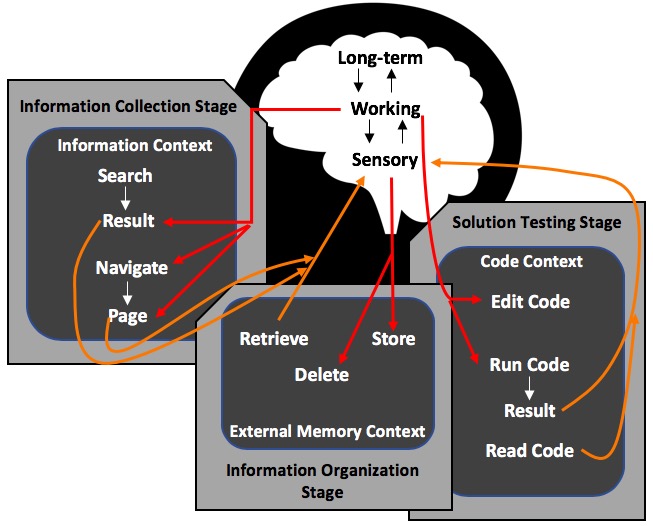
"Exploring Programmers' API Learning Processes: Collecting Web Resources as External Memory",
2020 IEEE Symposium on Visual Languages and Human-Centric Computing (VL/HCC), pp. 1–10, 2020.
[link]
[bibtex]
Kelleher, Caitlin and Brachman, Michelle,
A Sensemaking Analysis of API Learning Using React,
Journal of Computer Languages,
2022.
[link]
[bibtex]
Bibtex
@inproceedings{gao2020exploring,
                                             author = {Gao Gao and Finn Voichick and Michelle Ichinco and Caitlin Kelleher},
                                             booktitle = {2020 IEEE Symposium on Visual Languages and Human-Centric Computing (VL/HCC)},
                                             organization = {IEEE},
                                             pages = {1–10},
                                             title = {Exploring Programmers' API Learning Processes: Collecting Web Resources as External Memory},
                                             url = {https://www.cse.wustl.edu/~ckelleher/papers/exploringAPILearning.pdf},
                                             year = {2020}
} Bibtex
@article{kelleher2022sensemaking,
                                            author = {Kelleher, Caitlin and Brachman, Michelle},
                                            journal = {Journal of Computer Languages},
                                            publisher = {Elsevier},
                                            title = {A Sensemaking Analysis of API Learning Using React},
                                            url = {https://www.cse.wustl.edu/~ckelleher/papers/sensemakingAPILearning.pdf},
                                            year = {2022}
                                            }
Code Stories
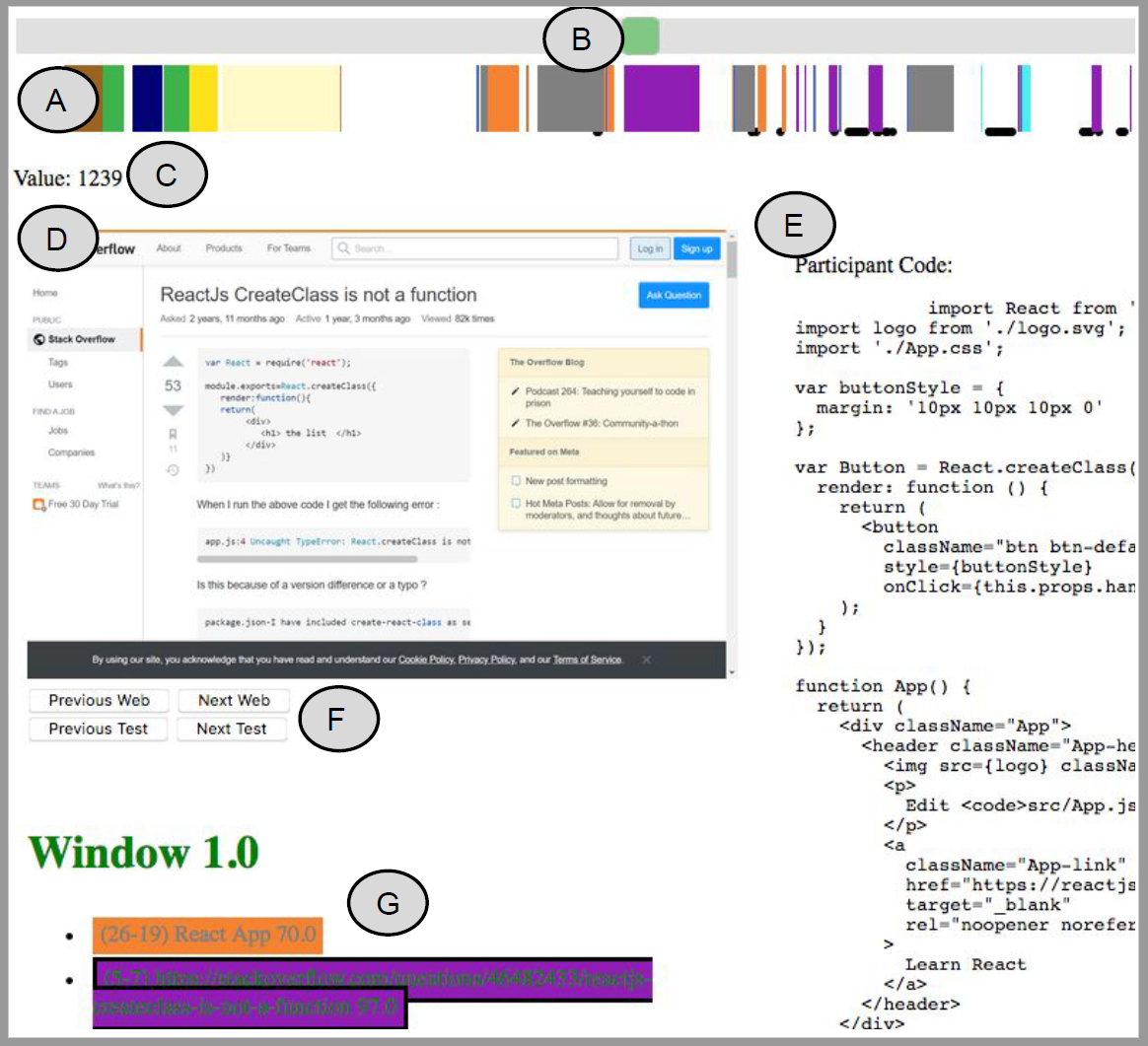
Understanding and using an existing codebase can be difficult. Programmers often struggle to answer basic questions: what code influences which aspects of the system? Why is it structured the way it is? Some of this information was observable during program creation but is not stored. Source code commits lump too many changes together, often representing the end state of a problem solving process but removing traces of the process, thereby making it difficult to understand the reasoning for them. Yet, there can also be too much information. Key stroke level histories are detailed but difficult to navigate and extract information from. We are working to create Code Stories that capture the history of how software programs evolved that organize changes based on a problem-solution structure and incorporate code history, output history and web foraging history to capture the influences that shape the code.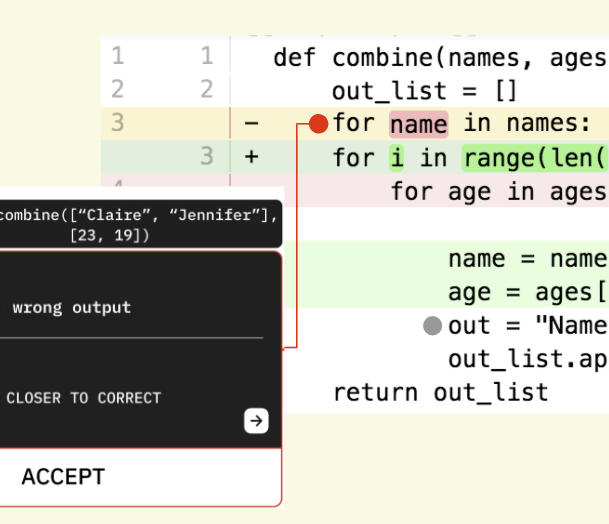
Tools to Support TAs
Universities increasingly rely on undergraduate TAs to provide accessible help for students in computer science courses. But, we know relatively little about how TAs and learners interact, how those practices compare to the best practices for tutoring, and where TAs could use some extra support. We are studying what occurs during help sessions, identifying barriers, and designing tools to address those barriers. The first such tool focuses on supporting TAs in debugging student code and understanding the bugs that exist in student code.
Selected Publications:
Malysheva, Yana and Allen, John and Kelleher, Caitlin,
How Do Teaching Assistants Teach? Characterizing the Interactions Between Students and TAs in a Computer Science Course,
2022 IEEE Symposium on Visual Languages and Human-Centric Computing (VL/HCC),
", pp1--9, "
2022.
[link]
[bibtex]
Malysheva, Yana and Kelleher, Caitlin,
An Algorithm for Generating Explainable Corrections to Student Code,
Proceedings of the 22nd Koli Calling International Conference on Computing Education Research,
", pp1--11, "
2022.
[link]
[bibtex]
Malysheva, Yana and Kelleher, Caitlin,
Assisting Teaching Assistants with Automatic Code Corrections,
CHI Conference on Human Factors in Computing Systems,
", pp1--18, "
2022.
[link]
[bibtex]
Bibtex
@inproceedings{malysheva2022teaching,
                                            author = {Malysheva, Yana and Allen, John and Kelleher, Caitlin},
                                            booktitle = {2022 IEEE Symposium on Visual Languages and Human-Centric Computing (VL/HCC)},
                                            organization = {IEEE},
                                            pages = {1--9},
                                            title = {How Do Teaching Assistants Teach? Characterizing the Interactions Between Students and TAs in a Computer Science Course},
                                            url = {https://www.cse.wustl.edu/~ckelleher/papers/taStudentInteractions.pdf},
                                            year = {2022}
                                            }
Bibtex
@inproceedings{malysheva2022algorithm,
                                            author = {Malysheva, Yana and Kelleher, Caitlin},
                                            booktitle = {Proceedings of the 22nd Koli Calling International Conference on Computing Education Research},
                                            pages = {1--11},
                                            title = {An Algorithm for Generating Explainable Corrections to Student Code},
                                            url = {https://www.cse.wustl.edu/~ckelleher/papers/explainableCorrections.pdf},
                                            year = {2022}
                                            }
Bibtex
@inproceedings{malysheva2022assisting,
                                            author = {Malysheva, Yana and Kelleher, Caitlin},
                                            booktitle = {CHI Conference on Human Factors in Computing Systems},
                                            pages = {1--18},
                                            title = {Assisting Teaching Assistants with Automatic Code Corrections},
                                            url = {https://dl.acm.org/doi/pdf/10.1145/3491102.3501820},
                                            year = {2022}
                                            }
Past Projects
Storytelling Alice
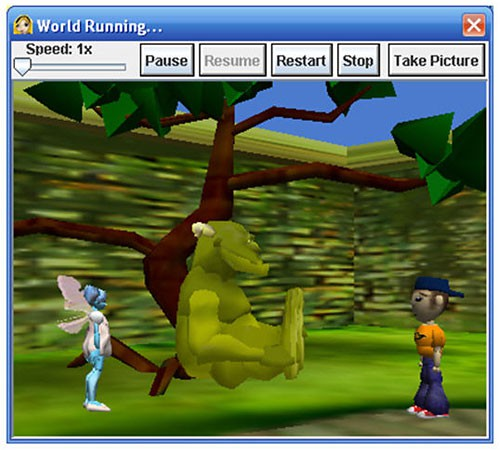
Storytelling Alice used storytelling as a means to the end of engaging middle school girls in computer programming. Rather than presenting programming as an end in itself, it was presented as a means of self-expression through stories created and reified using 3D animation. By designing the environment to support storytelling, it was significantly more successful at engaging young girls in programming. Users of Storytelling Alice spent 42% more time programming and were more than 3 times as likely to sneak extra time to program (51% vs 16%). In the years since Storytelling Alice, storytelling has become a fairly common approach for engaging a more gender-diverse audience in programming.
Selected Publications:
Caitlin Kelleher, Randy Pausch, Sara Kiesler,
"Storytelling alice motivates middle school girls to learn computer programming",
Proceedings of the SIGCHI conference on Human factors in computing systems, pp. 1455–1464, 2007.
[link]
[bibtex]
Caitlin Kelleher, Randy Pausch,
"Using storytelling to motivate programming",
Communications of the ACM, vol. 50, no. 7, pp. 58–64, 2007.
[link]
[bibtex]
Caitlin Kelleher, Randy Pausch,
"Lessons learned from designing a programming system to support middle school girls creating animated stories",
Visual languages and human-centric computing (VL/HCC'06), pp. 165–172, 2006.
[link]
[bibtex]
Bibtex
@inproceedings{kelleher2007storytelling,
                                            author = {Caitlin Kelleher and Randy Pausch and Sara Kiesler},
                                            booktitle = {Proceedings of the SIGCHI conference on Human factors in computing systems},
                                            pages = {1455–1464},
                                            title = {Storytelling alice motivates middle school girls to learn computer programming},
                                            url = {https://dl.acm.org/doi/10.1145/1240624.1240844?cid=81100607695},
                                            year = {2007}
} Bibtex
@article{kelleher2007using,
                                             author = {Caitlin Kelleher and Randy Pausch},
                                             journal = {Communications of the ACM},
                                             number = {7},
                                             pages = {58–64},
                                             publisher = {ACM},
                                             title = {Using storytelling to motivate programming},
                                             url = {https://dl.acm.org/doi/10.1145/1272516.1272540?cid=81100607695},
                                             volume = {50},
                                             year = {2007}
} Bibtex
@inproceedings{kelleher2006lessons,
                                             author = {Caitlin Kelleher and Randy Pausch},
                                             booktitle = {Visual languages and human-centric computing (VL/HCC'06)},
                                             organization = {IEEE},
                                             pages = {165–172},
                                             title = {Lessons learned from designing a programming system to support middle school girls creating animated stories},
                                             url = {https://www.cse.wustl.edu/~ckelleher/SupportAnimStoriesHCC.pdf},
                                             year = {2006}
} 
Games for Stroke Rehabilitation
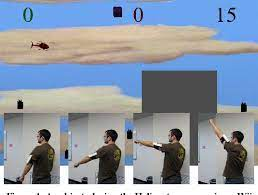
Roughly one in four of us can expect to experience a stroke at some point in our lives, often leading to long term disability. One of the challenges associated with recovering from a stroke is that each individual experiences a different injury, thus leading to a distinct set of deficits. Individualized rehabilitation is particularly critical. We did some of the early work on the design of personalizable games for stroke rehabilitation, helping to explore how to design games with a physical rehabilitation goal and how those games impacted individuals with stroke. Along the way, we developed novel strategies for calibrating games to account for changing daily needs as well as strategies for in-game reward systems.
Selected Publications:
Gazihan Alankus, Amanda Lazar, Matt May, Caitlin Kelleher,
"Towards customizable games for stroke rehabilitation",
Proceedings of the SIGCHI conference on human factors in computing systems, pp. 2113–2122, 2010.
[link]
[bibtex]
Gazihan Alankus, Rachel Proffitt, Caitlin Kelleher, Jack Engsberg,
"Stroke therapy through motion-based games: a case study",
ACM Transactions on Accessible Computing (TACCESS), vol. 4, no. 1, pp. 1–35, 2011.
[link]
[bibtex]
Gazihan Alankus, Caitlin Kelleher,
"Reducing compensatory motions in motion-based video games for stroke rehabilitation",
Human--Computer Interaction, vol. 30, no. 3-4, pp. 232–262, 2015.
[bibtex]
Bibtex
@inproceedings{alankus2010towards,
                                             author = {Gazihan Alankus and Amanda Lazar and Matt May and Caitlin Kelleher},
                                             booktitle = {Proceedings of the SIGCHI conference on human factors in computing systems},
                                             pages = {2113–2122},
                                             title = {Towards customizable games for stroke rehabilitation},
                                             url = {https://dl.acm.org/doi/10.1145/1753326.1753649?cid=81100607695},
                                             year = {2010}
} Bibtex
@article{alankus2011stroke,
                                             author = {Gazihan Alankus and Rachel Proffitt and Caitlin Kelleher and Jack Engsberg},
                                             journal = {ACM Transactions on Accessible Computing (TACCESS)},
                                             number = {1},
                                             pages = {1–35},
                                             publisher = {ACM New York, NY, USA},
                                             title = {Stroke therapy through motion-based games: a case study},
                                             url = {https://dl.acm.org/doi/10.1145/1878803.1878842?cid=81100607695},
                                             volume = {4},
                                             year = {2011}
} Bibtex
@article{alankus2015reducing,
                                             author = {Gazihan Alankus and Caitlin Kelleher},
                                             journal = {Human--Computer Interaction},
                                             number = {3-4},
                                             pages = {232–262},
                                             publisher = {Taylor \& Francis},
                                             title = {Reducing compensatory motions in motion-based video games for stroke rehabilitation},
                                             volume = {30},
                                             year = {2015}
} 
Supporting Novice Code Reuse
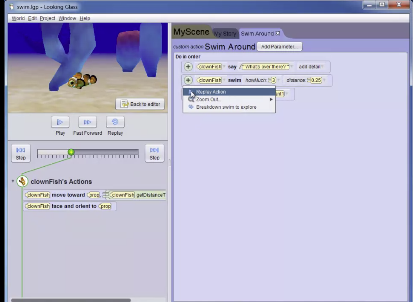
Formal opportunities to explore computer science are still relatively rare for young students. Consequently, it is important that programming environments for kids enable them to learn from each others' code. We have explored a variety of interfaces that record execution histories and allow users to interactively explore them to identify the behavior associated with each individual action or groups of actions. These tools also allow users to select action of interests to reuse in another program and guide the process of integrating selected code into that target program.
Selected Publications:
Paul A Gross, Micah S Herstand, Jordana W Hodges, Caitlin L Kelleher,
"A code reuse interface for non-programmer middle school students",
Proceedings of the 15th international conference on Intelligent user interfaces, pp. 219–228, 2010.
[link]
[bibtex]
Paul Gross, Jennifer Yang, Caitlin Kelleher,
"Dinah: An interface to assist non-programmers with selecting program code causing graphical output",
proceedings of the SIGCHI conference on human factors in computing systems, pp. 3397–3400, 2011.
[link]
[bibtex]
Bibtex
@inproceedings{gross2010code,
                                             author = {Paul A Gross and Micah S Herstand and Jordana W Hodges and Caitlin L Kelleher},
                                             booktitle = {Proceedings of the 15th international conference on Intelligent user interfaces},
                                             pages = {219–228},
                                             title = {A code reuse interface for non-programmer middle school students},
                                             url = {https://dl.acm.org/doi/10.1145/1719970.1720001?cid=81100607695},
                                             year = {2010}
} Bibtex
@inproceedings{gross2011dinah,
                                             author = {Paul Gross and Jennifer Yang and Caitlin Kelleher},
                                             booktitle = {proceedings of the SIGCHI conference on human factors in computing systems},
                                             pages = {3397–3400},
                                             title = {Dinah: An interface to assist non-programmers with selecting program code causing graphical output},
                                             url = {https://dl.acm.org/doi/10.1145/1978942.1979448?cid=81100607695},
                                             year = {2011}
} 
Generating and Presenting Tutorials
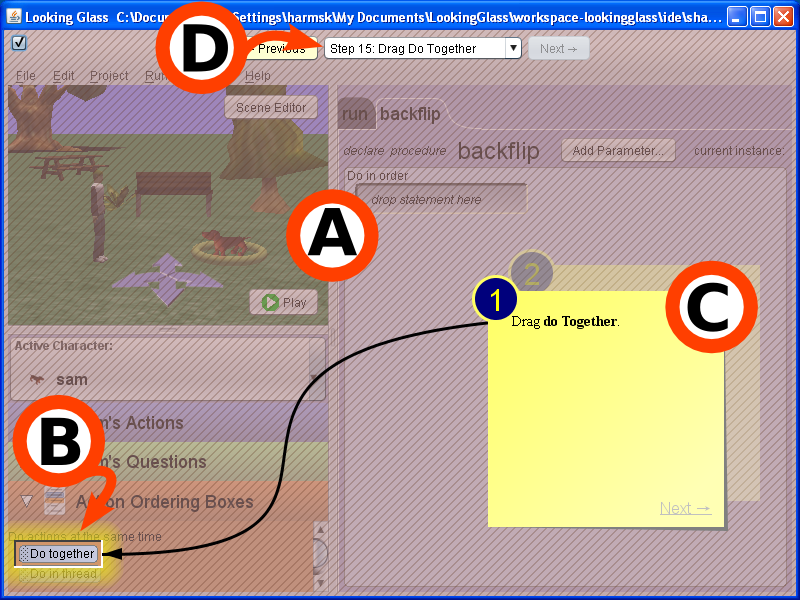
Formal opportunities to explore computer science are still relatively rare for young students. Consequently, it is important that programming environments for kids enable them to learn from each others' code. We have researched how novice programmers perform code localization and used that to design interfaces that 1) allow novices to select, adapt, and reuse code others have written within their own projects and 2) enable novices to explore and understand the behavior of code they did not write.
Selected Publications:
Caitlin Kelleher, Randy Pausch,
"Stencils-based tutorials: design and evaluation",
Proceedings of the SIGCHI conference on Human factors in computing systems, pp. 541–550, 2005.
[link]
[bibtex]
Kyle J Harms, Dennis Cosgrove, Shannon Gray, Caitlin Kelleher,
"Automatically generating tutorials to enable middle school children to learn programming independently",
Proceedings of the 12th International Conference on Interaction Design and Children, pp. 11–19, 2013.
[link]
[bibtex]
Bibtex
@inproceedings{kelleher2005stencils,
                                             author = {Caitlin Kelleher and Randy Pausch},
                                             booktitle = {Proceedings of the SIGCHI conference on Human factors in computing systems},
                                             pages = {541–550},
                                             title = {Stencils-based tutorials: design and evaluation},
                                             url = {https://dl.acm.org/doi/10.1145/1054972.1055047?cid=81100607695},
                                             year = {2005}
} Bibtex
@inproceedings{harms2013automatically,
                                             author = {Kyle J Harms and Dennis Cosgrove and Shannon Gray and Caitlin Kelleher},
                                             booktitle = {Proceedings of the 12th International Conference on Interaction Design and Children},
                                             pages = {11–19},
                                             title = {Automatically generating tutorials to enable middle school children to learn programming independently},
                                             url = {https://dl.acm.org/doi/10.1145/2485760.2485764?cid=81100607695},
                                             year = {2013}
} 
Code Puzzles and Cognitive Load
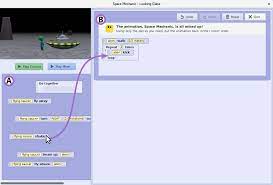
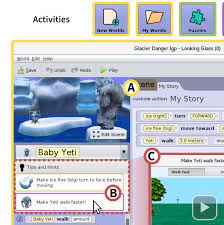
We explored the use of code puzzles similar to Parsons puzzles as a way to help kids learn to program. Our research contributed insights about how to design effective puzzles and the impact of distractor elements (code elements that are not part of the correct solution). We then created a model to predict the Cognitive Load a learner would experience from a selected puzzle, given their past history. Analysis of the underlying learned model revealed concepts that behaviors that were predictive of success.
Selected Publications:
Kyle J Harms, Noah Rowlett, Caitlin Kelleher,
"Enabling independent learning of programming concepts through programming completion puzzles",
2015 IEEE Symposium on Visual Languages and Human-Centric Computing (VL/HCC), pp. 271–279, 2015.
[link]
[bibtex]
Caitlin Kelleher, Wint Hnin,
"Predicting cognitive load in future code puzzles",
Proceedings of the 2019 CHI Conference on Human Factors in Computing Systems, pp. 1–12, 2019.
[link]
[bibtex]
Caitlin Kelleher, Wint Hnin,
"Predicting cognitive load in future code puzzles",
Proceedings of the 2019 CHI Conference on Human Factors in Computing Systems, pp. 1–12, 2019.
[link]
[bibtex]
Bibtex
@inproceedings{harms2015enabling,
                                             author = {Kyle J Harms and Noah Rowlett and Caitlin Kelleher},
                                             booktitle = {2015 IEEE Symposium on Visual Languages and Human-Centric Computing (VL/HCC)},
                                             organization = {IEEE},
                                             pages = {271–279},
                                             title = {Enabling independent learning of programming concepts through programming completion puzzles},
                                             url = {https://www.cse.wustl.edu/~ckelleher/papers/indLearningCompletionPuzzles.pdf},
                                             year = {2015}
} Bibtex
@inproceedings{kelleher2019predicting,
                                             author = {Caitlin Kelleher and Wint Hnin},
                                             booktitle = {Proceedings of the 2019 CHI Conference on Human Factors in Computing Systems},
                                             pages = {1–12},
                                             title = {Predicting cognitive load in future code puzzles},
                                             url = {https://dl.acm.org/doi/pdf/10.1145/3290605.3300487},
                                             year = {2019}
} 
Static Code Suggestions
Sometimes the most difficult questions are the ones you don't realize that you should be asking. In this project, we explored using static code analysis of programmers' code as they were working to suggest methods and programming constructs that might be relevant to them. These were presented in a side panel of options. Our results suggest that this is a potentially valuable form of support that is currently rare in systems. Novice programmers chose to engage with these suggested items more frequently than any other form of support available, including documentation, tutorials, and code puzzles. Further, suggestions appealed to a substantially broader proportion of users than other forms of support: 70% of users used suggestions vs 27.5% for the next most used form.
Selected Publications:
Wint Hnin, Michelle Ichinco, Caitlin Kelleher,
"An Exploratory Study of the Usage of Different Educational Resources in an Independent Context",
2017 IEEE Symposium on Visual Languages and Human-Centric Computing (VL/HCC), pp. 181–189, 2017.
[link]
[bibtex]
Michelle Ichinco, Wint Yee Hnin, Caitlin L Kelleher,
"Suggesting api usage to novice programmers with the example guru",
Proceedings of the 2017 CHI Conference on Human Factors in Computing Systems, pp. 1105–1117, 2017.
[link]
[bibtex]
Bibtex
@inproceedings{hnin2017exploratory,
                                             author = {Wint Hnin and Michelle Ichinco and Caitlin Kelleher},
                                             booktitle = {2017 IEEE Symposium on Visual Languages and Human-Centric Computing (VL/HCC)},
                                             pages = {181–189},
                                             title = {An Exploratory Study of the Usage of Different Educational Resources in an Independent Context},
                                             url = {https://www.cse.wustl.edu/~ckelleher/papers/resourcesIndependentContext.pdf},
                                             year = {2017}
} Bibtex
@inproceedings{ichinco2017suggesting,
                                             author = {Michelle Ichinco and Wint Yee Hnin and Caitlin L Kelleher},
                                             booktitle = {Proceedings of the 2017 CHI Conference on Human Factors in Computing Systems},
                                             pages = {1105–1117},
                                             title = {Suggesting api usage to novice programmers with the example guru},
                                             url = {https://dl.acm.org/doi/pdf/10.1145/3025453.3025827},
                                             year = {2017}
                                            }